

If you’ve watched television during Medicare’s Annual Enrollment Period, checked your mailbox, or searched online for Medicare information, you’ve probably seen advertisements promoting $0 Medicare Advantage plans.
For many people, those ads raise an important question:
“How can a health insurance plan cost $0 per month?”
The answer is simpler than most people think.
A $0 Medicare Advantage plan does not mean you receive free healthcare. Instead, it means the insurance company doesn’t charge an additional monthly premium for the Medicare Advantage plan itself.
These plans are approved by Medicare and offered by private insurance companies that contract with the federal government to provide your Medicare-covered benefits. Many also include valuable extra benefits that Original Medicare doesn’t cover, such as routine dental, vision, hearing, prescription drug coverage, fitness memberships, and other wellness benefits.
Understanding what “$0 premium” actually means—and what it doesn’t—can help you make a more informed Medicare decision.
Quick Answer
A $0 Medicare Advantage plan means you do not pay an additional monthly premium for the plan itself.
However, most beneficiaries still pay their Medicare Part B premium, and you may also have copayments, coinsurance, deductibles (depending on the plan), and prescription drug costs when you receive healthcare services.
The “$0” refers only to the plan premium—not your total healthcare expenses.
What Is a $0 Medicare Advantage Plan?
Medicare Advantage, also known as Medicare Part C, is an alternative way to receive your Original Medicare benefits.
Instead of the federal government paying healthcare providers directly, Medicare contracts with private insurance companies to administer your Medicare-covered services.
By law, every Medicare Advantage plan must cover all medically necessary services covered by Original Medicare (Part A and Part B). Many plans also include additional benefits that Original Medicare generally doesn’t provide.
When you see a $0 premium Medicare Advantage plan, it simply means the insurance company has chosen not to charge an additional monthly premium for the plan.
That does not mean your healthcare is free.
Most Medicare beneficiaries continue paying their monthly Medicare Part B premium. Depending on the plan you choose, you may also pay copayments, coinsurance, deductibles, and prescription drug costs when you receive covered services.
How a $0 Medicare Advantage Plan Works
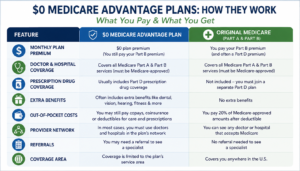
This is where many people become confused.
If the insurance company isn’t collecting a monthly premium from you, how can it afford to provide coverage?
The answer is that Medicare pays Medicare Advantage plans a monthly amount for each enrolled member to administer their Medicare-covered benefits.
Insurance companies use those payments to provide your Medicare-covered healthcare and, in many cases, offer additional benefits that Original Medicare doesn’t include.
That’s why a plan can legitimately have a $0 monthly premium while still providing comprehensive Medicare coverage.
It’s important to remember that “$0 premium” refers only to the monthly plan premium—not your overall healthcare costs.
💬 From My Office
One of the biggest misconceptions I hear is:
“If the premium is $0, there must be a catch.”
The reality is that many $0 Medicare Advantage plans provide excellent value for the right person.
Rather than focusing only on the monthly premium, I encourage my clients to ask a different question:
Does this plan fit my doctors, hospitals, prescription medications, expected healthcare needs, and budget?
Choosing the right Medicare plan isn’t about finding the cheapest option—it’s about finding the coverage that best fits your individual needs.
Common Benefits Included With Many $0 Medicare Advantage Plans
Benefits vary by insurance company and location, but many plans may include:
- ✅ Hospital coverage (Part A)
- ✅ Medical coverage (Part B)
- ✅ Prescription drug coverage (Part D)
- ✅ Routine dental benefits
- ✅ Routine vision benefits
- ✅ Hearing benefits
- ✅ Telehealth services
- ✅ Fitness memberships
- ✅ Over-the-counter (OTC) allowances
- ✅ Preventive care
- ✅ An annual maximum out-of-pocket limit for covered Part A and Part B services
Important: Benefits, provider networks, prescription drug formularies, copayments, and out-of-pocket costs vary by plan. Always review the plan’s Evidence of Coverage (EOC) and provider directory before enrolling.
Key Takeaway
A $0 Medicare Advantage plan doesn’t mean healthcare is free—it means you don’t pay an additional monthly premium for the Medicare Advantage plan itself.
Most beneficiaries continue paying their Medicare Part B premium and may still have out-of-pocket costs, such as copayments, coinsurance, deductibles (if applicable), and prescription drug expenses.
Understanding how these plans work is the first step toward choosing Medicare coverage that fits your healthcare needs, budget, and lifestyle.
What Costs Will You Still Pay With a $0 Medicare Advantage Plan?
One of the biggest misconceptions about $0 Medicare Advantage plans is that they eliminate all healthcare costs.
While these plans don’t charge an additional monthly premium, they don’t eliminate every expense associated with your healthcare.
Understanding the costs you may still pay can help you avoid surprises and choose a plan that fits both your healthcare needs and your budget.
You Will Usually Continue Paying Your Medicare Part B Premium
For most people, enrolling in a $0 Medicare Advantage plan does not replace your Medicare Part B premium.
Instead, you’ll continue paying your monthly Part B premium while paying no additional premium for the Medicare Advantage plan itself.
Some Medicare Advantage plans offer a Part B premium reduction benefit (sometimes called a “Giveback” benefit), which helps pay part—or, in some cases, all—of your Part B premium. However, these plans aren’t available everywhere and vary by county.
Good to Know: Even if two Medicare Advantage plans both have a $0 monthly premium, one may include a Part B Giveback benefit while the other does not.
You May Pay Copayments or Coinsurance
Just like many employer health insurance plans, Medicare Advantage plans generally require you to share some of the cost when you receive healthcare services.
Depending on your plan, you may pay:
- A copayment for a primary care doctor’s visit
- A copayment for a specialist appointment
- Coinsurance for outpatient surgery
- Copayments for emergency room visits
- Daily copayments for hospital stays
- Copayments for physical therapy, occupational therapy, or other covered services
These costs vary from plan to plan, which is why it’s important to compare more than just the monthly premium.
Prescription Drugs May Have Their Own Costs
Most Medicare Advantage plans include Medicare Part D prescription drug coverage, but that doesn’t mean every prescription is free.
Your prescription drug costs depend on several factors, including:
- Whether your medication is on the plan’s formulary (covered drug list)
- The drug’s tier
- Whether prior authorization or step therapy is required
- Which pharmacy you use
- Whether you’ve reached your annual out-of-pocket prescription drug limit
If you take medications regularly, always check that they’re covered before enrolling in a plan.
Understanding Your Annual Maximum Out-of-Pocket Limit
One of the biggest advantages of Medicare Advantage is something many people don’t realize they have—a built-in financial safety net.
Every Medicare Advantage plan includes an annual maximum out-of-pocket limit for covered Medicare Part A and Part B services.
Once your spending on covered services reaches that limit, your plan pays 100% of the cost for covered Part A and Part B services for the remainder of the calendar year.
Original Medicare doesn’t include this type of protection unless you have additional coverage, such as a Medigap policy.
For many beneficiaries, this annual spending limit provides valuable peace of mind in the event of a serious illness or unexpected hospitalization.
Comparison at a Glance
| Cost | Original Medicare | $0 Medicare Advantage Plan |
|---|---|---|
| Monthly Part B Premium | ✔ Usually Required | ✔ Usually Required |
| Additional Plan Premium | Not Applicable | ✔ $0 for many plans |
| Copayments & Coinsurance | Typically 20% coinsurance after the Part B deductible for many Part B services | Varies by plan |
| Prescription Drug Coverage | Requires a separate Part D plan | Usually included |
| Annual Maximum Out-of-Pocket Limit | No (unless you have supplemental coverage such as Medigap) | ✔ Yes, for covered Part A and Part B services |
💬 From My Office
One of the first questions people ask me is:
“What’s the monthly premium?”
While that’s an important question, it shouldn’t be the only one.
I’ve seen people save a few dollars each month by choosing one plan, only to spend much more during the year because their doctors weren’t in the network or their medications had higher copayments.
A good Medicare plan isn’t simply the one with the lowest premium—it’s the one that provides the best overall value based on your doctors, prescriptions, expected healthcare needs, and budget.
Common Myth
Myth: “If a Medicare Advantage plan has a $0 premium, it must have hidden costs.”
Fact:
There are no hidden costs simply because a plan has a $0 monthly premium.
Every Medicare Advantage plan must clearly disclose its premiums, copayments, coinsurance, deductibles, provider network, prescription drug coverage, and annual maximum out-of-pocket limit.
Before enrolling, you’ll have access to documents such as the Evidence of Coverage (EOC) and Summary of Benefits, which explain exactly how the plan works.
The key isn’t avoiding $0 premium plans—it’s understanding the complete picture before making your decision.
Key Takeaway
A $0 Medicare Advantage plan can provide excellent value, but the monthly premium is only one part of the equation.
When comparing plans, look beyond the “$0” and consider:
- Your monthly Medicare Part B premium
- Copayments and coinsurance
- Prescription drug coverage
- Provider networks
- Extra benefits
- The annual maximum out-of-pocket limit
Taking the time to compare these features can help you choose a Medicare Advantage plan that supports both your health and your financial goals.
How to Choose the Right $0 Medicare Advantage Plan
By now, you know that a $0 Medicare Advantage plan doesn’t necessarily mean “free” healthcare. You also understand that the monthly premium is only one part of the overall cost.
So how do you decide whether one plan is better than another?
The answer is simple:
Don’t shop by premium alone.
The best Medicare Advantage plan isn’t always the one with the lowest monthly cost. It’s the one that provides the best overall value based on your healthcare needs.
1. Make Sure Your Doctors Are in the Plan’s Network
One of the first things you should check is whether your primary care physician, specialists, hospitals, and other healthcare providers participate in the plan’s network.
Many Medicare Advantage plans use provider networks, such as:
- HMO (Health Maintenance Organization) plans, which generally require you to receive routine care from in-network providers and often require referrals for specialists.
- PPO (Preferred Provider Organization) plans, which typically allow you to see both in-network and out-of-network providers, although out-of-network care usually costs more.
If keeping your current doctors is important to you, verify that they’re participating providers before enrolling.
2. Review Your Prescription Drug Coverage
Even if two Medicare Advantage plans have the same $0 monthly premium, their prescription drug coverage can be very different.
Before choosing a plan, confirm that:
- Your medications are included on the plan’s formulary (covered drug list).
- Your preferred pharmacy participates in the network.
- Your medications aren’t subject to unexpected restrictions, such as prior authorization, quantity limits, or step therapy.
- Your estimated annual prescription costs fit your budget.
For many people, prescription drug coverage can have a greater financial impact than the monthly premium itself.
3. Compare Total Healthcare Costs
A low monthly premium doesn’t always mean you’ll spend less over the course of the year.
Compare items such as:
- Primary care copayments
- Specialist copayments
- Hospital costs
- Emergency room copayments
- Outpatient surgery costs
- Diagnostic imaging costs
- Physical therapy copayments
Sometimes a plan with slightly higher copayments may still be the right choice if it includes your preferred doctors and medications.
The goal is to look at the overall value, not just one number.
4. Look at the Extra Benefits
Many Medicare Advantage plans include benefits that Original Medicare generally doesn’t cover.
Depending on your location and plan, these may include:
- Routine dental services
- Routine vision care
- Hearing exams and hearing aid benefits
- Fitness memberships
- Over-the-counter (OTC) allowances
- Transportation assistance
- Meal benefits following certain hospital stays
- Telehealth services
Remember, these benefits vary by plan and county. A benefit available on one plan may not be offered on another.
5. Understand the Annual Maximum Out-of-Pocket Limit
One of the most valuable features of Medicare Advantage is its annual maximum out-of-pocket limit for covered Part A and Part B services.
If you experience a serious illness or require extensive medical care, this limit helps protect you from unlimited medical expenses during the year.
When comparing plans, don’t just look at the monthly premium—compare the maximum out-of-pocket limit as well.
A lower limit may provide greater financial protection if you need significant healthcare services.
How Do $0 Medicare Advantage Plans Work in New York?
If you live in Nassau County or elsewhere on Long Island, you may have several Medicare Advantage plans to choose from. While all Medicare Advantage plans must provide the same basic Medicare-covered services, the available plans, provider networks, prescription drug formularies, premiums, copayments, and extra benefits can vary depending on your ZIP code. For a local example, see how $0 Medicare Advantage plans work in Freeport, NY.
That’s why it’s important to compare your options each year during Medicare’s enrollment periods. A plan that works well for someone living in another county—or even another part of New York—may not be available where you live or may offer different costs and benefits.
Taking the time to review your Medicare Advantage options annually can help ensure your preferred doctors, hospitals, and prescription medications continue to be covered while giving you the best value for your healthcare needs.
Questions to Ask Before You Enroll
Before making your decision, ask yourself:
✔ Are my doctors in the network?
✔ Are my prescriptions covered?
✔ Can I afford the copayments if I need medical care?
✔ Does the plan include benefits I’ll actually use?
✔ Am I comfortable with the plan’s annual maximum out-of-pocket limit?
If you can confidently answer “yes” to these questions, you’ve likely found a plan that’s worth considering.
💬 From My Office
One of the biggest mistakes I see isn’t choosing the “wrong” Medicare Advantage plan—it’s choosing a plan without comparing the details.
Advertisements often highlight a $0 monthly premium or extra benefits, but those features don’t tell the whole story.
I encourage every client to compare provider networks, prescription drug coverage, estimated out-of-pocket costs, and extra benefits before making a decision.
Taking a few extra minutes to review these details today can help prevent unexpected costs and frustrations later.
Key Takeaway
A $0 Medicare Advantage plan can be an excellent choice, but the monthly premium is only one part of the decision.
Before enrolling, compare:
- Your doctors
- Your medications
- Your expected healthcare costs
- The provider network
- Extra benefits
- The annual maximum out-of-pocket limit
Choosing a plan based on your overall healthcare needs—not just the monthly premium—can help you get the most value from your Medicare coverage.
About the Author
Aja Link is an independent Medicare insurance agent serving Nassau County, Long Island, and surrounding New York communities. She helps Medicare beneficiaries compare Medicare Advantage, Medicare Supplement (Medigap), and Medicare Part D prescription drug plans, making it easier to choose coverage that fits their healthcare needs, budget, and lifestyle.
Whether you’re new to Medicare or reviewing your coverage during the Annual Enrollment Period, Aja is committed to providing clear, educational guidance so you can make informed Medicare decisions with confidence.
Phone: (516) 313-8918
Email: ajaglink@gmail.com
References
The following official resources provide additional information about Medicare Advantage plans, Medicare coverage, and comparing health plans: