

Medicare Advantage HMO vs. PPO in New York: Which Plan Is Right for You?
By Aja Link, Licensed Medicare Agent Serving New York
Table of Contents
- Introduction
- What Is Medicare Advantage?
- Why Choosing the Right Plan Matters
- What Is an HMO Medicare Advantage Plan?
- What Is a PPO Medicare Advantage Plan?
- HMO vs. PPO: Side-by-Side Comparison
- Which Plan May Be Right for You?
- Five Questions to Ask Before You Enroll
- Common Medicare Advantage Mistakes
- Frequently Asked Questions
- Key Takeaways
- Helpful Resources
Introduction
Turning 65 should be an exciting milestone—not a stressful one.
Yet for many New Yorkers, becoming eligible for Medicare brings more questions than answers. Your mailbox may suddenly fill with brochures. Television commercials promise extra benefits. Friends tell you to choose the plan they have, while family members offer advice based on their own experiences.
Before long, you may find yourself wondering:
“What is the difference between an HMO and a PPO?”
“Will I still be able to see my doctors?”
“Which Medicare Advantage plan is actually right for me?”
If you have asked yourself any of these questions, you are certainly not alone.
As a licensed Medicare agent serving individuals throughout New York, I have conversations like these regularly. One thing I have learned is that Medicare does not have to feel confusing. When someone explains the choices in plain English, they become much easier to understand.
The truth is that there is no single Medicare Advantage plan that is best for everyone. The right plan depends on your healthcare needs, doctors, prescriptions, budget, travel habits, and personal preferences.
My goal is to help you understand the differences between HMO and PPO Medicare Advantage plans so you can make an informed decision with greater confidence.
What Is Medicare Advantage?
Before comparing HMO and PPO plans, let’s begin with the basics.
Medicare Advantage, also known as Medicare Part C, is another way to receive most of your Medicare Part A and Part B benefits. Instead of receiving those benefits directly through Original Medicare, you enroll in a Medicare-approved plan offered by a private insurance company that contracts with Medicare.
Medicare Advantage plans must cover almost all medically necessary services covered by Original Medicare. Original Medicare generally remains responsible for certain services, including hospice care and some costs associated with approved clinical research studies.
Many Medicare Advantage plans also include benefits or services that Original Medicare does not generally cover. Depending on the plan, these may include:
- Medicare prescription drug coverage
- Routine dental services
- Routine vision services and eyewear allowances
- Routine hearing services and hearing-aid benefits
- Fitness programs
- Telehealth services
- Transportation for certain healthcare needs
- Allowances for eligible over-the-counter products
These extra benefits are not the same in every plan. Availability, coverage limits, provider networks, premiums, copayments, and other costs can vary by insurance company, plan, and county.
Many people appreciate the convenience of receiving their medical and prescription drug coverage through one plan. However, convenience should not be the only consideration. It is equally important to review the plan’s doctors, hospitals, pharmacies, prescription drug list, costs, and coverage rules.
Why Choosing the Right Plan Matters
When comparing Medicare Advantage plans, it is natural to focus on the monthly premium—especially when some plans advertise a low or even $0 additional plan premium.
However, the monthly premium is only one part of the total cost of your healthcare. You must generally continue paying your Medicare Part B premium, and you may also be responsible for plan copayments, coinsurance, deductibles, and other out-of-pocket expenses.
Think about how you currently receive healthcare.
Do you visit specialists regularly?
Is keeping your current primary care doctor important to you?
Do you receive care from more than one hospital system?
Do you travel or spend part of the year outside New York?
Would you rather have lower, more predictable costs or greater freedom to choose providers?
The answers to these questions can have a greater effect on your experience than the monthly plan premium alone.
The goal is not simply to choose the least expensive plan. It is to choose a plan that fits the way you receive healthcare.
What Is an HMO Medicare Advantage Plan?
HMO stands for Health Maintenance Organization.
An HMO plan is built around a network of doctors, specialists, hospitals, and other healthcare providers. In general, members must use providers and facilities within the plan’s network for routine covered care.
Most HMO plans require members to select a primary care physician, commonly called a PCP. Your primary care physician may serve as the central point of contact for your healthcare and help coordinate care with specialists.
Depending on the plan, you may need a referral before seeing certain specialists. Because referral requirements differ, it is important to read the plan’s rules rather than assuming that every HMO works the same way.
With limited exceptions, an HMO generally will not cover routine care received outside its network. Emergency care, urgent care, and out-of-area dialysis are important exceptions covered according to Medicare and plan rules. Some HMO Point-of-Service plans may also cover certain non-emergency services outside the network, usually at a higher cost.
Advantages of an HMO
An HMO may be attractive because it can offer:
- Lower costs for certain services
- Predictable copayments
- Coordinated care among participating providers
- An established network of doctors and facilities
- A strong emphasis on preventive and primary care
For someone who receives most medical care close to home, has doctors who participate in the network, and is comfortable following the plan’s referral and network rules, an HMO may be a good fit.
When an HMO May Not Be the Best Fit
An HMO may be less suitable if you:
- Spend several months of the year outside the plan’s service area
- Regularly see specialists in different healthcare systems
- Want routine access to non-network providers
- Have doctors or hospitals that do not participate in the plan
- Prefer not to obtain referrals when a plan requires them
These circumstances do not automatically rule out an HMO. However, they are important factors to review before enrolling.
What Is a PPO Medicare Advantage Plan?
PPO stands for Preferred Provider Organization.
The primary appeal of a PPO is greater provider flexibility.
A PPO has a network of preferred doctors, hospitals, specialists, and other healthcare providers. You will generally pay less when you receive covered care from providers within that network.
PPO plans may also cover Medicare-covered services received from out-of-network providers. However, your share of the cost is usually higher, and an out-of-network provider must be willing and eligible to provide the service under the plan’s rules. Before receiving non-emergency care outside the network, it is wise to confirm coverage with both the plan and the provider.
PPO plans generally do not require you to choose a primary care physician, and referrals are generally not required before seeing a specialist. Individual plan rules can still differ, so you should always review the plan documents.
A PPO may be appealing if you:
- See several specialists
- Receive care through multiple healthcare systems
- Travel frequently or spend part of the year away from home
- Want the option to use certain out-of-network providers
- Prefer to see specialists without obtaining referrals
That additional flexibility may come with higher copayments, coinsurance, premiums, or maximum out-of-pocket limits. A PPO is not automatically better than an HMO; it simply provides a different balance between flexibility and cost.
The right choice depends on which doctors and hospitals you use, how often you travel, the medications you take, the services you expect to need, and how much provider flexibility matters to you.
HMO vs. PPO: Side-by-Side Comparison
Both HMO and PPO Medicare Advantage plans provide Medicare-covered hospital and medical benefits. The most important differences generally involve provider networks, referrals, flexibility, and cost.
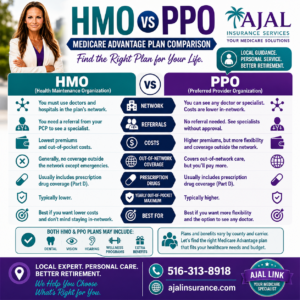
This chart provides a general comparison. Individual plans may work differently, so always review the plan’s Evidence of Coverage, provider directory, drug formulary, and Summary of Benefits before enrolling.
Which Plan May Be Right for You?
The letters “HMO” and “PPO” do not tell you whether a plan is good or bad. They tell you how the plan is structured.
A well-matched HMO can be better for one person, while a PPO may be more appropriate for someone else.
An HMO may be worth considering if:
- Your doctors and preferred hospitals participate in the plan’s network.
- You receive most of your routine healthcare close to home.
- You are comfortable choosing a primary care physician.
- You do not mind obtaining referrals when the plan requires them.
- You value coordinated care and potentially lower costs.
- You rarely need routine medical care outside the plan’s service area.
A PPO may be worth considering if:
- You want the option to use certain out-of-network providers.
- You receive care from doctors in several healthcare systems.
- You regularly see specialists and prefer not to obtain referrals.
- You travel frequently or spend part of the year away from home.
- You are willing to pay more for additional provider flexibility.
- You want more freedom when choosing where to receive covered care.
It is also important to understand that having a PPO does not mean every doctor in the country is guaranteed to accept your plan.
Before visiting an out-of-network provider for non-emergency care, contact both the plan and the provider. Confirm that the service is covered, that any required authorization has been obtained, and that the provider is willing to treat you under the plan’s payment terms.
Important reminder:
A PPO offers more flexibility than an HMO, but it does not necessarily provide nationwide routine care without restrictions. Emergency and urgently needed care are different from scheduled, non-emergency services.
A New York Example
Consider two Medicare beneficiaries living in New York.
Maria receives nearly all her healthcare close to home. Her primary care doctor, cardiologist, preferred hospital, and pharmacy participate in the same HMO network. She does not travel often and is comfortable asking her primary care physician to help coordinate specialist care.
An HMO may provide Maria with the structure she prefers while helping her manage her healthcare costs.
Robert, on the other hand, sees specialists affiliated with different hospital systems. He also spends several weeks each year visiting family outside New York and wants the option to receive certain non-emergency services outside his plan’s network.
Robert may place a higher value on the flexibility of a PPO, even if some services cost more.
Neither person is making the “better” choice in every situation. Each is choosing based on individual healthcare needs and lifestyle.
That is the most important lesson when comparing Medicare Advantage plans: the right plan should fit the person—not the other way around.
Five Questions to Ask Before You Enroll
Before choosing an HMO or PPO Medicare Advantage plan, ask yourself these five questions.
- Are my doctors and hospitals in the network?
Do not assume that a doctor accepts a particular Medicare Advantage plan simply because the office accepts Medicare.
Original Medicare and Medicare Advantage provider participation are not the same thing. A doctor may accept Original Medicare but not participate in a specific Medicare Advantage network.
Check each important provider individually, including:
- Your primary care physician
- Specialists
- Hospitals
- Medical groups
- Outpatient facilities
- Laboratories
- Pharmacies
- Durable medical equipment suppliers
Provider directories can change. It is wise to check the plan’s directory and call the provider’s office directly before enrolling.
- Are my prescriptions covered?
Most Medicare Advantage plans include Medicare Part D prescription drug coverage, but each plan has its own formulary, or list of covered medications.
A drug may be covered differently from one plan to another. Check:
- Whether each prescription is covered
- The drug’s cost-sharing tier
- Whether prior authorization is required
- Whether step therapy applies
- Whether there are quantity limits
- Which pharmacies are preferred
- Whether mail-order service is available
A low-premium plan may not be a good value if your prescriptions are expensive under that plan.
- What will I pay when I use healthcare?
Look beyond the monthly premium.
Compare costs for services you are likely to use, such as:
- Primary care visits
- Specialist visits
- Diagnostic tests
- MRIs, CT scans, and other advanced imaging
- Outpatient surgery
- Hospital stays
- Physical therapy
- Ambulance services
- Skilled nursing facility care
- Prescription drugs
Every Medicare Advantage plan has an annual limit on what you pay for covered Part A and Part B services. That limit varies by plan. Once you reach the plan’s applicable limit, the plan pays the covered cost of those Part A and Part B services for the remainder of the calendar year.
Prescription drug expenses are tracked separately under Medicare Part D rules.
- How often do I travel?
Emergency and urgently needed care are covered when you are away from home. However, routine non-emergency care may be handled differently.
An HMO may work well for someone who takes occasional vacations but receives routine care in New York. Someone who lives in another state for part of the year may need to examine network access more carefully.
Even with a PPO, confirm how the plan covers routine out-of-network care and whether providers at your destination will accept the plan.
Medicare coverage outside the United States is generally limited. Some Medicare Advantage plans may provide additional worldwide emergency or urgent-care benefits, but coverage rules and limits vary.
- What rules must I follow?
Before enrolling, find out whether the plan requires:
- Specialist referrals
- Prior authorization for certain services
- Use of designated laboratories or facilities
- In-network pharmacies
- Step therapy for certain medications
- Approval before receiving out-of-network care
These rules do not automatically make a plan unsuitable. However, you should understand them before you need medical care—not after a claim is submitted.
Do Not Choose Based on Extra Benefits Alone
Dental, vision, hearing, fitness, transportation, and over-the-counter benefits can be valuable. However, they should not be the only reason you choose a Medicare Advantage plan.
A generous dental allowance may look attractive, but it will not make up for losing access to an important cardiologist. A large over-the-counter benefit may not be helpful if your prescriptions are not covered affordably.
Start with the essentials:
- Your doctors and hospitals
- Your prescriptions
- Your expected healthcare costs
- The plan’s network and coverage rules
- Your travel and lifestyle needs
After those needs are satisfied, compare the additional benefits.
The extras should help distinguish between plans that already meet your core healthcare needs. They should not distract you from those needs.
Common Medicare Advantage Mistakes New Yorkers Make
Choosing a Medicare Advantage plan isn’t something you should rush. Every year, I speak with people who enrolled in a plan that looked great at first but didn’t fit their healthcare needs.
Fortunately, many of these mistakes can be avoided with a little research and planning.
Mistake #1: Choosing a Plan Based Only on the Monthly Premium
A low—or even $0—monthly plan premium can certainly be appealing, but it doesn’t tell the whole story.
It’s equally important to compare:
- Copayments
- Coinsurance
- Prescription drug costs
- Provider networks
- The plan’s annual maximum out-of-pocket limit
- Coverage for the healthcare services you use most often
The lowest premium isn’t always the lowest overall cost.
Mistake #2: Assuming Your Doctor Accepts Every Medicare Advantage Plan
Many physicians accept Medicare, but that does not automatically mean they participate in every Medicare Advantage plan.
Before enrolling, confirm that your:
- Primary care physician
- Specialists
- Preferred hospital
- Pharmacy
all participate in the specific plan you’re considering.
Mistake #3: Forgetting to Check Prescription Drug Coverage
If your Medicare Advantage plan includes prescription drug coverage, review the plan’s formulary carefully.
Ask yourself:
- Are all of my medications covered?
- Are they on a preferred tier?
- Is prior authorization required?
- Can I use my preferred pharmacy?
Prescription costs can vary significantly from one plan to another.
Mistake #4: Choosing a Plan Based on Television Commercials
Television advertisements can introduce you to Medicare Advantage, but they don’t tell your whole story.
The plan that works well for someone else may not be the best fit for you.
Your healthcare needs, doctors, prescriptions, travel habits, and budget are unique.
Mistake #5: Not Reviewing Coverage Every Year
Medicare Advantage plans can change from year to year.
Provider networks, prescription drug formularies, premiums, copays, and extra benefits may all change.
That’s why reviewing your coverage during Medicare’s Annual Enrollment Period is one of the best ways to make sure your plan still meets your needs.
Frequently Asked Questions
Is an HMO better than a PPO?
Neither is universally better.
An HMO may be a great choice for someone who wants coordinated care, uses local healthcare providers, and is comfortable following network rules.
A PPO may be a better fit for someone who values provider flexibility, sees multiple specialists, or travels frequently.
The best plan is the one that fits your healthcare needs.
Can I switch Medicare Advantage plans later?
Yes.
During certain Medicare enrollment periods, many beneficiaries have the opportunity to review their coverage and make changes if another plan better meets their needs.
Can I see a specialist without a referral?
It depends on the plan.
Many PPO plans do not require referrals for specialists.
Many HMO plans do require referrals, although requirements vary by plan.
Always review the plan’s rules before enrolling.
Will Medicare Advantage cover emergency care?
Yes.
Medicare Advantage plans cover emergency and urgently needed care according to Medicare and plan rules, whether you’re at home or traveling within the United States.
Can I keep my current doctor?
Maybe.
The only way to know for sure is to verify that your doctor participates in the specific Medicare Advantage plan you’re considering.
Never assume participation based solely on the fact that your doctor accepts Medicare.
Key Takeaways
Choosing between an HMO and a PPO isn’t about finding the “best” Medicare Advantage plan.
It’s about finding the plan that best fits your life.
If you value lower costs, coordinated care, and receiving most of your healthcare close to home, an HMO may be an excellent choice.
If you prefer greater flexibility, see multiple specialists, or travel frequently, a PPO may provide the freedom you’re looking for.
Before enrolling, take time to compare:
- Your doctors
- Your hospitals
- Your prescriptions
- Your expected healthcare costs
- Provider networks
- Your lifestyle and travel habits
The more informed your decision, the more confident you’ll feel about your Medicare coverage.
Final Thoughts
Medicare is not one-size-fits-all, and neither are Medicare Advantage plans.
The “right” plan isn’t necessarily the one your neighbor chose or the one you saw advertised on television. It’s the plan that helps you receive the healthcare you need, from the providers you trust, at a cost that fits your budget.
If there’s one piece of advice I’d leave you with, it’s this:
Take the time to ask questions.
Understanding your options today can help you avoid surprises tomorrow.
Whether you’re turning 65, retiring, moving to New York, or simply reviewing your current Medicare coverage, comparing your options carefully is one of the best investments you can make in your future healthcare.
About the Author
Aja Link is a licensed Medicare insurance agent who helps individuals throughout New York understand their Medicare options with confidence.
She believes Medicare should be explained in plain English—not confusing insurance language—so people can make informed decisions about their healthcare.
Whether you’re new to Medicare or reviewing your coverage during an enrollment period, Aja is committed to helping you understand your options and choose coverage that fits your individual needs.
Phone: 516-313-8918
Email: ajaglink@gmail.com
Helpful Resources
For additional information about Medicare and Medicare Advantage plans, visit these trusted resources:
- Medicare.gov – https://www.medicare.gov
- Compare Medicare Health & Drug Plans – https://www.medicare.gov/plan-compare
- Centers for Medicare & Medicaid Services (CMS) – https://www.cms.gov
- New York State Department of Health – https://health.ny.gov
- HIICAP (Health Insurance Information, Counseling and Assistance Program) – https://aging.ny.gov/health-insurance-information-counseling-and-assistance-program-hiicap
Disclaimer: This article is intended for educational purposes only and should not be considered legal, tax, or medical advice. Medicare plan benefits, provider networks, premiums, formularies, and costs can change from year to year and may vary by county. Always review the official plan documents and consult with a licensed Medicare professional before making enrollment decisions.