
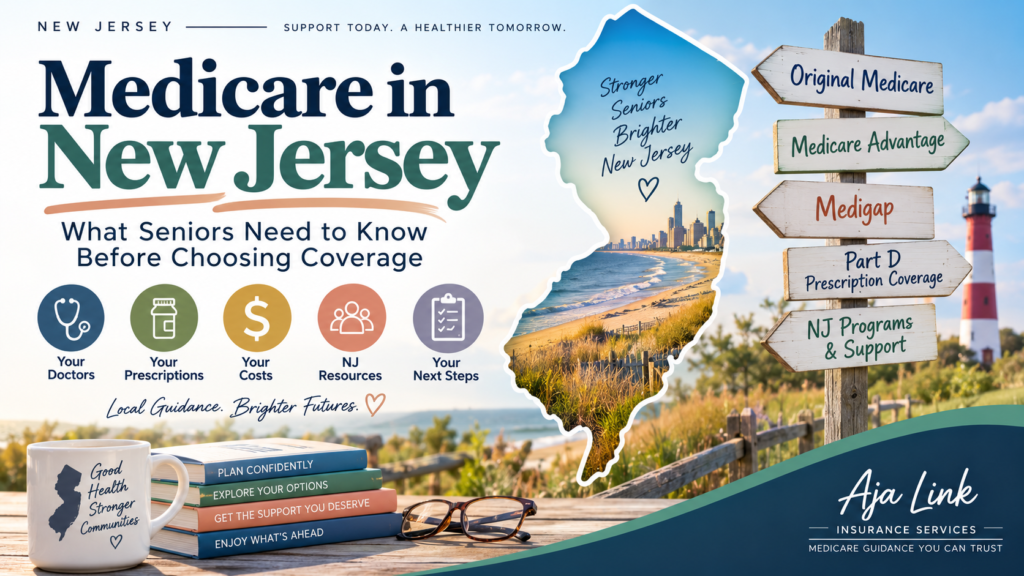
If you’re trying to understand Medicare in New Jersey, you probably don’t need another article that simply tells you what the letters A, B, C and D stand for.
You need to know how those pieces come together when it’s time to make an actual decision about your healthcare.
Should you stay with Original Medicare?
Should you consider Medicare Advantage?
If you choose Original Medicare, should you add a Medigap policy?
How will your prescriptions be covered?
Will your doctors still be accessible?
What could you pay if you have a year when you need a lot more healthcare than usual?
And are there New Jersey programs that could help you with Medicare costs?
Those are the questions that matter.
Medicare gives you choices, but having more choices doesn’t necessarily make the decision easier. Two people who live in the same New Jersey town, are the same age and enroll in Medicare at the same time could reasonably choose very different coverage.
That’s because Medicare should be compared around the person—not just the plan.
Your doctors, specialists, prescriptions, preferred hospitals, budget, travel habits and comfort with different types of healthcare costs all deserve a place in the conversation.
This guide will help you understand what to look at before choosing Medicare coverage in New Jersey—and, just as importantly, what not to overlook.
Table of Contents
- 1. Medicare in New Jersey Starts With One Major Decision
- 2. Medicare Advantage vs. Original Medicare: Don’t Start With the Premium
- 3. Where Does Medigap Fit Into Medicare in New Jersey?
- 4. New Jersey Medicare Beneficiaries Have Resources Many People Don’t Know About
- 5. Your Doctors and Hospitals Should Be One of the First Things You Check
- 6. Prescription Drug Coverage Deserves Its Own Medicare Comparison
- 7. Medicare Advantage vs. Original Medicare + Medigap in New Jersey
- 8. When Can You Change Medicare Coverage in New Jersey?
- 9. Frequently Asked Questions About Medicare in New Jersey
Medicare in New Jersey Starts With One Major Decision
Once you have Medicare Part A and Part B, there are two main ways to receive your Medicare health coverage:
Original Medicare or Medicare Advantage.
That decision affects many of the other choices you’ll make, including how you receive prescription drug coverage, whether you can purchase Medigap, how provider access works and how you pay for healthcare throughout the year. Medicare describes these as the two primary ways to receive Medicare coverage.
Before comparing individual insurance companies or plans, I think it’s important to understand this bigger decision first.
Option 1: Original Medicare
Original Medicare is provided by the federal government and includes:
Medicare Part A — Hospital Insurance
and
Medicare Part B — Medical Insurance
With Original Medicare, you can generally use any doctor or hospital anywhere in the United States that accepts Medicare. You don’t have to choose a primary care doctor, and in most cases you don’t need a referral to see a specialist.
But Original Medicare doesn’t pay 100% of every covered healthcare expense.
For example, after meeting the Part B deductible, you generally pay 20% of the Medicare-approved amount for Part B-covered services.
Original Medicare also has no annual out-of-pocket maximum on what you could spend for covered Part A and Part B services unless you have other coverage that helps with those costs.
That’s where additional coverage can become important.
If you choose Original Medicare, you may also decide to add:
- A Medicare Supplement Insurance policy (Medigap) to help with certain out-of-pocket costs
- A separate Medicare Part D plan for prescription drug coverage
That combination can look very different from Medicare Advantage.
Option 2: Medicare Advantage
Medicare Advantage, also called Medicare Part C, is another way to receive your Medicare benefits.
Instead of receiving your Part A and Part B benefits directly through Original Medicare, you enroll in a Medicare-approved private health plan.
You still have Medicare, and you must continue to have Part A and Part B to join a Medicare Advantage plan.
Most Medicare Advantage plans also include Medicare Part D prescription drug coverage, and many offer additional benefits that Original Medicare doesn’t cover, which can include certain dental, vision and hearing benefits.
But there can be important differences from Original Medicare.
Depending on the plan, you may need to use providers within a network for non-emergency care. Some plans provide out-of-network coverage, often at a higher cost.
You may also encounter copayments, coinsurance, referrals or prior authorization requirements depending on the plan and service.
One important protection is that Medicare Advantage plans have an annual limit on what you pay out of pocket for covered Medicare services. The specific limit and cost-sharing vary by plan.
So when someone tells me:
“This Medicare Advantage plan has a $0 premium.”
My response isn’t that the plan is good or bad.
My response is:
“Let’s look at the rest of it.”
Because the premium is only one part of your healthcare costs.
Medicare Advantage vs. Original Medicare: Don’t Start With the Premium
One of the easiest Medicare mistakes to make is comparing coverage based on the number that’s easiest to see.
Usually, that’s the monthly premium.
But Medicare coverage involves more than what leaves your bank account every month.
Look at Your Total Healthcare Picture
When comparing Medicare options in New Jersey, I would want to know:
What will you pay each month?
But I would also want to know:
What happens when you actually use the coverage?
For example:
- What would you pay to see a specialist?
- What could an outpatient procedure cost?
- What would happen financially if you were hospitalized?
- How are diagnostic tests handled?
- What does your prescription coverage look like?
- Is there an annual out-of-pocket maximum?
- Are your doctors and hospitals accessible under the coverage?
- Will prior authorization be required for certain services?
A plan with a lower monthly premium could potentially have more costs when you receive healthcare.
Another coverage arrangement might require higher monthly premiums but reduce certain medical cost-sharing.
Neither structure is automatically right or wrong.
The important question is:
Which type of cost structure are you more comfortable managing?
From My Office
When I help someone think through Medicare, I don’t like starting with:
“How much is the premium?”
I like starting with:
“Tell me about your healthcare.”
Who is your primary doctor?
Do you see specialists?
Are there doctors you absolutely don’t want to lose?
Which hospitals would you prefer to use?
What prescriptions do you take?
Do you travel?
What kind of medical expenses would make you uncomfortable?
Those answers give us something meaningful to work with.
Only then does it make sense to start comparing coverage.
Where Does Medigap Fit Into Medicare in New Jersey?
Medigap is one of the most misunderstood pieces of Medicare.
A Medigap policy is not another type of Medicare Advantage plan.
Medigap works with Original Medicare.
Medicare Supplement Insurance—usually called Medigap—is private insurance designed to help pay certain out-of-pocket costs left by Original Medicare, such as copayments, coinsurance and, depending on the policy, certain deductibles.
Original Medicare remains your primary coverage.
Medigap supplements it.
A Common Original Medicare Combination
Someone choosing this route may have:
Medicare Part A
Medicare Part B
Medigap
A separate Part D prescription drug plan
That may sound like a lot of pieces compared with a Medicare Advantage plan that bundles several benefits together.
But the two approaches are intentionally different.
With Original Medicare, you generally have broad nationwide access to doctors and hospitals that accept Medicare.
With Medicare Advantage, provider networks and plan rules can play a larger role.
With Medigap, you’re paying an additional monthly premium to help cover certain costs left by Original Medicare.
With Medicare Advantage, you may have a lower or even $0 additional plan premium, depending on the plan, while paying copayments or coinsurance when you use certain healthcare services. You must also continue paying your Medicare Part B premium.
That’s why comparing the two based solely on monthly premiums can be misleading.
Medigap Doesn’t Cover Everything
Medigap shouldn’t be confused with comprehensive coverage for everything Original Medicare doesn’t cover.
Medigap policies generally don’t cover routine dental or vision care, hearing aids, long-term care or private-duty nursing.
Medigap policies sold after 2005 also don’t include prescription drug coverage, which is why someone with Original Medicare and Medigap will generally need a separate Part D plan if they want Medicare drug coverage.
Timing Matters With Medigap
This is something I want New Jersey Medicare beneficiaries to understand before they make their initial coverage decision.
Your federal Medigap Open Enrollment Period generally gives you six months after your Part B coverage starts to purchase a Medigap policy. During this protected period, you can buy any Medigap policy sold in your state even if you have health problems.
After that period, your ability to buy Medigap later can be different unless you have another applicable enrollment protection or guaranteed issue right.
This is why I don’t like telling someone:
“You can always switch later.”
With Medicare, the ability to change coverage can depend on what you’re changing from, what you’re changing to, when you’re making the change and whether special protections apply.
Understanding those rules before making your first decision can be just as important as comparing the coverage itself.
New Jersey Medicare Beneficiaries Have Resources Many People Don’t Know About
This is one place where a New Jersey Medicare guide should go beyond explaining federal Medicare.
New Jersey has its own programs and resources that can be extremely valuable.
New Jersey SHIP Provides Free Medicare Counseling
The New Jersey State Health Insurance Assistance Program, better known as SHIP, provides free assistance to Medicare beneficiaries who have questions or problems involving their health insurance.
SHIP counselors can help beneficiaries understand Medicare benefits, claims, Medigap and other health insurance options.
The program doesn’t sell or endorse specific insurance products, companies, agents or plans. New Jersey currently has SHIP counseling available throughout all 21 counties.
That’s an excellent resource for someone who wants free, independent Medicare counseling.
NJSave May Help With More Than You Realize
Another resource I want more New Jersey seniors to know about is NJSave.
NJSave is an application New Jersey uses to help eligible older adults and individuals with disabilities access programs that can reduce Medicare premiums, prescription costs and other living expenses.
Depending on eligibility, NJSave can provide access to programs including:
- Medicare Savings Programs
- Medicare Part D Extra Help
- Pharmaceutical Assistance to the Aged and Disabled (PAAD)
- Senior Gold
- Hearing Aid Assistance to the Aged and Disabled (HAAAD)
- Lifeline Utility Assistance
The application can also screen people for additional assistance programs.
I think this is important because some people assume they won’t qualify for assistance and never investigate.
Don’t make that decision for the program.
If healthcare and prescription costs are putting pressure on your budget, it’s worth checking the current eligibility requirements.
Medicare Savings Programs Can Help Eligible New Jersey Residents
New Jersey also administers Medicare Savings Programs for eligible residents with limited income and assets.
Depending on the program you qualify for, assistance may help with the Medicare Part B premium and, in some cases, additional Medicare cost-sharing.
New Jersey currently administers the Qualified Medicare Beneficiary (QMB), Specified Low-Income Medicare Beneficiary (SLMB) and Qualifying Individual (QI) programs, with eligibility requirements that are updated periodically.
Because income and asset limits can change, I recommend checking New Jersey’s current requirements rather than relying on an old article, flyer or number someone gave you several years ago.
The bigger point is simple:
Before assuming Medicare is unaffordable, find out whether you’re eligible for help.
Your Doctors and Hospitals Should Be One of the First Things You Check
One of the most important questions in Medicare is also one of the simplest:
“Can I continue seeing the doctors I want to see?”
For many New Jersey residents, that question matters more than an extra benefit or a low advertised premium.
Think about the healthcare relationships you’ve already built.
Your primary care physician.
Your cardiologist.
Your orthopedist.
Your oncologist.
Your endocrinologist.
The hospital or health system you would want to use if something serious happened.
Those relationships shouldn’t become an afterthought when you’re comparing Medicare coverage.
Original Medicare and Provider Choice
With Original Medicare, you can generally use any doctor or hospital anywhere in the United States that accepts Medicare.
For someone who wants broad provider flexibility, that’s an important feature to understand.
You aren’t selecting a Medicare Advantage provider network. Instead, you need to determine whether the doctor or facility accepts Medicare.
Medicare Advantage Networks Work Differently
Medicare Advantage plans can have provider networks, and the rules depend partly on the type of plan.
For example, with a Medicare Advantage HMO, you generally need to receive care from providers within the plan’s network except for certain situations such as emergency care, out-of-area urgent care and temporary out-of-area dialysis. Most HMOs also require referrals to see specialists.
A Medicare Advantage PPO generally provides more flexibility to receive covered services outside the network, but you will usually pay more when you do. PPOs generally don’t require referrals to specialists.
That makes the letters HMO and PPO much more than insurance terminology.
They can affect how you actually receive healthcare.
“My Doctor Takes Medicare” Isn’t Enough Information
This is a distinction I want people to understand.
If you have Original Medicare, asking whether your doctor accepts Medicare makes sense.
If you’re considering Medicare Advantage, the question needs to become more specific:
“Does my doctor participate in this particular Medicare Advantage plan and network?”
Those aren’t the same question.
And don’t check only your primary care physician.
If you’ve been seeing the same cardiologist for eight years, that physician could be more important to your decision than an additional benefit being advertised by the plan.
From My Office
If you handed me a list of five Medicare plans, I wouldn’t want to begin by telling you which one has the longest list of benefits.
I’d rather begin with a piece of paper containing the names of your doctors.
Then your specialists.
Then your preferred hospitals.
Then your prescriptions.
That’s your Medicare starting point.
A plan can look fantastic on paper and still be a poor match for your life if the healthcare providers who matter most to you don’t work with it.
Prescription Drug Coverage Deserves Its Own Medicare Comparison
Medical coverage and prescription coverage are related, but I don’t believe they should be evaluated as if they’re the same decision.
Your medications deserve their own review.
Most Medicare Advantage plans include Medicare Part D prescription drug coverage. If you have Original Medicare and want prescription coverage, you can generally enroll in a separate Part D plan.
But simply having Part D coverage doesn’t tell you what you’ll pay for your medications.
Every Prescription List Is Personal
Imagine two New Jersey residents who live next door to each other.
They’re both 68.
They see some of the same doctors.
They both have Medicare.
One takes two inexpensive generic medications.
The other takes six prescriptions, including a higher-cost brand-name drug.
Their prescription needs could make their Medicare costs very different.
That’s why I don’t like statements such as:
“This is a great drug plan.”
My question would be:
“Is it a good fit for the medications you take?”
Check the Exact Medication, Not Just the Drug Plan Premium
When reviewing prescription coverage, have your medication list in front of you.
For every prescription, know:
- The exact drug name
- The dosage
- How often you take it
- The pharmacy you prefer
- Whether you would consider mail order
Then investigate how the plan covers those medications.
Medicare drug plans can have coverage rules such as prior authorization, and you or your prescriber may sometimes need to request an exception when a drug isn’t on the formulary or when a coverage rule needs to be waived.
Pharmacy choice can matter too. Medicare explains that plans may have in-network and preferred in-network pharmacies, and using a preferred pharmacy can sometimes reduce your out-of-pocket prescription costs.
So don’t compare Part D plans based only on monthly premium.
A lower-premium plan isn’t necessarily less expensive for your particular prescriptions.
Review Prescription Coverage Every Year
This is something I encourage Medicare beneficiaries to take seriously.
Your medications can change.
Your plan can change.
Its formulary can change.
Your costs can change.
Pharmacy arrangements can change.
That means the drug coverage that worked for you this year shouldn’t automatically be assumed to be your best fit next year.
Annual Medicare review isn’t just about finding something different. Sometimes the review confirms that what you already have still works well for you.
That’s valuable too.
Medicare Advantage HMO vs. PPO in New Jersey: Know the Difference
If you’re considering Medicare Advantage in New Jersey, you’ll likely encounter terms such as HMO and PPO.
Don’t skim past them.
They can substantially affect how you use your coverage.
Medicare Advantage HMO
With an HMO, you generally receive non-emergency healthcare through the plan’s network.
You will usually choose a primary care physician, and in most HMO plans you’ll need a referral to see a specialist.
Going outside the network can potentially leave you responsible for the full cost unless an exception applies or the plan has a point-of-service feature.
An HMO can work well for someone whose doctors and preferred healthcare facilities participate in the network and who is comfortable following the plan’s structure.
But that makes checking the network especially important.
Medicare Advantage PPO
A PPO also has a provider network, but you generally have the option to receive covered services from out-of-network Medicare providers, usually at a higher cost.
PPO plans generally don’t require you to choose a primary care doctor or obtain a referral to see a specialist.
That additional flexibility can be important to some people.
But don’t interpret “PPO” as meaning:
“I can see anyone anywhere for the same price.”
In-network and out-of-network costs can be different.
You still need to examine the actual plan.
Prior Authorization Matters Too
Provider networks aren’t the only plan rule to consider.
Medicare states that Medicare Advantage members will typically need prior authorization before the plan covers certain services or supplies.
Prior authorization doesn’t mean the service isn’t covered.
It means the plan may need to approve the service under its rules before it will cover it.
If you receive ongoing treatment, use expensive medical equipment or regularly need certain procedures, understanding a plan’s rules can be particularly important.
Medicare Advantage vs. Original Medicare + Medigap in New Jersey
There is no single column in this chart that everyone should prefer.
The purpose is to show how differently these two approaches to Medicare can work.
| What to Compare | Medicare Advantage | Original Medicare + Medigap |
|---|---|---|
| How Medicare benefits are received | Through a Medicare-approved private plan | Original Medicare remains primary; Medigap supplements certain Original Medicare costs |
| Doctors & hospitals | Provider networks may apply | Generally any U.S. provider that accepts Medicare |
| Specialist referrals | Depends on plan type; HMOs commonly require them while PPOs generally don’t | Generally no referral required under Original Medicare |
| Monthly costs | You continue paying Part B; the Medicare Advantage plan may have an additional premium, including some $0-premium plans | Part B premium + Medigap premium + generally a separate Part D premium if drug coverage is desired |
| Medical cost-sharing | Copayments and coinsurance vary by plan and service | Medigap helps pay certain Original Medicare cost-sharing according to the policy |
| Annual medical out-of-pocket protection | Plans have an annual limit for covered Part A and Part B services | Original Medicare itself has no annual out-of-pocket maximum; Medigap can cover certain Original Medicare cost-sharing |
| Prescription coverage | Included in most Medicare Advantage plans | Generally requires a separate Part D plan |
| Dental, vision & hearing | Some plans offer additional benefits | Medigap generally doesn’t cover routine dental, vision or hearing aids |
| Prior authorization | May be required for certain services or supplies | Original Medicare generally doesn’t require prior authorization for most services, although certain items and services may be subject to Medicare authorization requirements |
| Nationwide provider access | Depends on the plan’s network and rules | Generally any provider nationwide that accepts Medicare |
These are general differences. Specific Medicare Advantage benefits, costs and networks vary by plan, while Medigap coverage depends on the standardized plan selected.
Think About How You Use Healthcare Outside New Jersey
This question is easy to overlook when you’re sitting at home comparing plans.
Do you travel?
Not just vacations.
Do you spend part of the winter in Florida?
Do your children live in another state?
Do you regularly visit family for extended periods?
Would you want the ability to arrange routine healthcare while you’re away?
These questions can change how you evaluate Medicare coverage.
Original Medicare Provides Broad Nationwide Access
Original Medicare generally allows you to use any doctor or hospital in the United States that accepts Medicare.
For someone who frequently travels domestically or spends substantial time in another state, that flexibility may be particularly important.
Medigap works alongside Original Medicare, so it doesn’t replace that Original Medicare provider structure with a separate medical network.
Medicare Advantage Requires a More Detailed Travel Conversation
Medicare Advantage plans can have networks and service areas.
That doesn’t mean someone who travels can’t choose Medicare Advantage.
It means “I travel” needs to become a more detailed conversation.
Someone who takes one two-week vacation each year may have very different needs from someone who spends four months every winter outside New Jersey.
If you travel frequently, ask:
- How does the plan cover emergency care while I’m away?
- What about urgent care?
- Can I receive routine non-emergency care outside the service area?
- Does the plan provide out-of-network coverage?
- What would I pay?
- What happens if I spend several months somewhere else?
A Medicare Advantage PPO may provide covered out-of-network services, generally at a higher cost, while an HMO typically has stricter network requirements for routine care.
The details of the specific plan matter.
Don’t Let Extra Benefits Make the Entire Decision
Dental.
Vision.
Hearing.
Over-the-counter allowances.
Fitness benefits.
These are some of the additional benefits that can attract attention when people compare Medicare Advantage plans.
And they can absolutely have value.
But I don’t want an extra benefit to distract you from the coverage you’ll rely on when you’re sick.
Ask What the Benefit Actually Provides
Seeing the word “dental” on a benefits summary isn’t enough.
Ask:
What services are covered?
Is there an annual allowance or maximum?
Which dentists participate?
Are preventive and comprehensive services treated differently?
What would you pay for more expensive dental work?
Apply that same thinking to vision and hearing benefits.
The headline tells you a benefit exists.
The details tell you what that benefit is actually worth to you.
From My Office
If you’re deciding between Medicare options, I would put your priorities in this order:
Your healthcare first. Your extras second.
I’d rather know that we’ve carefully reviewed your physicians, specialists, hospitals, prescriptions and potential medical costs before we start getting excited about an additional benefit.
That doesn’t make extra benefits unimportant.
It puts them in perspective.
A valuable extra benefit should make an already appropriate coverage choice more attractive—not convince you to overlook a problem with your core medical coverage.
When Can You Change Medicare Coverage in New Jersey?
Choosing Medicare coverage isn’t necessarily a decision you’ll keep forever.
Your health can change.
Your prescriptions can change.
Your doctors can change.
Medicare Advantage and Part D plans can change their costs, benefits, formularies and provider networks from year to year.
But there is an important distinction:
Wanting to change Medicare coverage doesn’t necessarily mean you can make every type of change whenever you want.
Medicare has specific enrollment periods, and Medigap has its own rules.
Understanding those rules can prevent one of the most frustrating Medicare situations: deciding what you want to change before finding out whether you can make that change the way you expected.
Medicare Open Enrollment: October 15–December 7
Medicare’s annual Open Enrollment Period runs from October 15 through December 7.
During this period, Medicare beneficiaries can make changes such as switching Medicare Advantage plans, moving between Original Medicare and Medicare Advantage, or changing Medicare prescription drug coverage. Changes generally take effect January 1.
This is why I encourage people to review their coverage every fall.
A review doesn’t mean you need to switch.
Sometimes the best result of an annual review is discovering that your current coverage still works well for you.
Changing to Medigap Is a Different Conversation
This is where I want people to be particularly careful.
You may have an opportunity to leave Medicare Advantage and return to Original Medicare, but that does not automatically mean you have an unrestricted right to purchase any Medigap policy you want.
Outside your Medigap Open Enrollment Period, federal law doesn’t guarantee that an insurance company will sell you a Medigap policy unless you qualify for a guaranteed issue right or another protection. Depending on your circumstances and applicable state rules, medical underwriting may be involved.
There are important exceptions. For example, Medicare provides certain trial rights for people in specific situations involving Medicare Advantage and Medigap.
That’s why this is not an area where I recommend relying on:
“Someone told me I can always switch later.”
Find out what rights apply to your specific situation before giving up coverage you may not be able to get back under the same circumstances.
7 Medicare Mistakes I Want New Jersey Seniors to Avoid
There are plenty of ways to compare Medicare coverage.
Sometimes it’s equally helpful to look at the decisions I wouldn’t want you to make.
Mistake #1: Choosing a Plan Because Someone You Know Loves It
Your friend may love their Medicare coverage.
That’s useful to know.
But your friend may have different doctors, prescriptions, health conditions, finances and travel habits.
Medicare is too personal for someone else’s experience to make the decision for you.
Mistake #2: Looking Only at the Monthly Premium
A low premium can be attractive.
But ask what happens when you use the coverage.
Look at specialist costs, hospital costs, outpatient services, prescriptions, deductibles, coinsurance and the annual out-of-pocket structure where applicable.
Premium is one number. Your healthcare costs are a much bigger picture.
Mistake #3: Checking Your Primary Doctor but Forgetting Your Specialists
Don’t stop after verifying your primary care physician.
Think about the doctors who could be especially difficult to replace.
If you’ve been seeing the same cardiologist, oncologist, neurologist or other specialist for years, include that physician in your comparison.
And if you’re considering Medicare Advantage, verify participation in the specific plan and network, rather than simply asking whether the physician “takes Medicare.”
Mistake #4: Assuming All Prescription Drug Coverage Is Basically the Same
It isn’t.
Your medication list needs to be compared against the coverage you’re considering.
A plan that works extremely well for someone taking two generic prescriptions may look very different for someone taking multiple medications or a higher-cost brand-name drug.
Mistake #5: Letting Dental or Other Extra Benefits Drive the Decision
Extra benefits can absolutely provide value.
But your core medical coverage should make sense first.
I’d rather see you choose coverage that works for your doctors, prescriptions and healthcare needs and then evaluate the extras—not the other way around.
Mistake #6: Assuming You Can Always Buy Medigap Later
Outside your Medigap Open Enrollment Period, you may not have the same federal protections you had when you first became eligible. Medicare states that outside this period, fewer options may be available, a policy may cost more, or an insurer may be permitted to deny an application if you don’t qualify for a guaranteed issue protection.
Before leaving Medigap or assuming you can obtain it later, understand the rules that apply to your circumstances.
Mistake #7: Assuming You Make Too Much Money to Get Help
Don’t rule yourself out without checking.
New Jersey’s NJSave application provides access to several assistance programs, including Medicare Savings Programs and Medicare Part D Extra Help, as well as state programs such as PAAD and Senior Gold.
Eligibility requirements change, so check the current guidelines rather than relying on something you heard several years ago.
A New Jersey Medicare Checklist Before You Enroll
Before enrolling in Medicare coverage, I recommend sitting down with the information that actually reflects your life.
You don’t need a giant spreadsheet.
Start with this:
Your doctors:
Write down your primary care physician and every specialist you want to continue seeing.
Your hospitals:
Think about the hospitals and healthcare systems you would prefer to use.
Your prescriptions:
List the exact medication, dosage and frequency for everything you take.
Your pharmacy:
Include the pharmacy you prefer and whether you would consider mail order.
Your healthcare usage:
Think realistically about how often you see doctors and specialists and whether you receive ongoing treatments.
Your travel:
Consider whether you spend significant time outside New Jersey or travel frequently.
Your budget:
Think about both monthly premiums and the medical expenses you could face when you use healthcare.
Your priorities:
Ask yourself whether provider flexibility, predictable expenses, lower monthly premiums, additional benefits or some combination matters most to you.
Then compare Medicare coverage against that information.
Not against an advertisement.
Not against your neighbor’s plan.
Not against whichever plan has the longest benefits list.
Against your life.
Frequently Asked Questions About Medicare in New Jersey
What Is the Best Medicare Plan in New Jersey?
There isn’t one Medicare plan that’s best for every New Jersey beneficiary.
Your appropriate options depend on factors such as where you live, your doctors, prescriptions, healthcare usage, budget and coverage preferences.
Even two spouses can sometimes have different Medicare needs.
A more useful question is:
“Which available Medicare coverage works best with my individual healthcare needs and priorities?”
Is Medicare Different in New Jersey Than in Other States?
Medicare is a federal program, so the fundamental rules for Original Medicare apply nationally.
However, where you live still matters.
Medicare Advantage and Part D plan availability can vary geographically, Medigap premiums and availability can differ, and states administer programs that may help eligible residents with Medicare expenses.
New Jersey also operates resources such as SHIP and NJSave. New Jersey SHIP currently provides counseling throughout all 21 counties and maintains information on Medicare Advantage, Medigap and Part D options offered in the state.
Does New Jersey Have Medicare Advantage Plans?
Yes.
Medicare Advantage plans are available in New Jersey, although the specific plans available to you depend on your service area and can change from year to year.
New Jersey SHIP publishes information about Medicare Advantage plans currently offered in the state, while Medicare’s Plan Compare can be used to research options available based on your location.
Can I Have Medicare Advantage and Medigap Together?
No.
Medigap is designed to supplement Original Medicare, not Medicare Advantage.
If you’re enrolled in Medicare Advantage, an insurance company generally can’t sell you a Medigap policy unless you’re switching back to Original Medicare under applicable rules.
Can I Switch From Medicare Advantage to Medigap in New Jersey?
Potentially, but there are two separate issues to consider.
First, you need an enrollment opportunity that allows you to leave Medicare Advantage and return to Original Medicare.
Second, you need to determine whether you have the right to purchase the Medigap policy you want.
Outside your Medigap Open Enrollment Period, federal guaranteed-issue protections apply only in certain situations, and additional state rights may also matter.
Check your Medigap eligibility before completing the Medicare Advantage change whenever possible.
Where Can New Jersey Seniors Get Free Medicare Help?
New Jersey’s State Health Insurance Assistance Program (SHIP) provides free Medicare counseling.
SHIP counselors can help beneficiaries understand benefits, claims, Medigap and other health insurance options. They don’t sell, recommend or endorse a particular insurance product, company, agent or plan.
What Is NJSave?
NJSave is a New Jersey application that helps eligible older adults and people with disabilities access programs that can reduce Medicare premiums, prescription costs and other expenses.
Programs accessed through NJSave include Medicare Savings Programs, Part D Extra Help, PAAD, Senior Gold, HAAAD and Lifeline Utility Assistance.
Can New Jersey Help Pay My Medicare Part B Premium?
Eligible New Jersey residents may qualify for a Medicare Savings Program.
New Jersey administers QMB, SLMB and QI. Depending on the program, assistance can include the Part B premium, and QMB can provide additional help with Medicare-covered deductibles, coinsurance and copayments. Eligibility is based on current income and asset requirements.
Final Thoughts: Medicare Should Fit Your Life, Not the Other Way Around
If there’s one thing I want you to take away from this guide, it’s this:
Don’t begin your Medicare decision with an insurance company. Begin with yourself.
Your doctors.
Your specialists.
Your prescriptions.
Your preferred hospitals.
Your budget.
Your travel.
Your healthcare needs.
And what you want your coverage to feel like when you actually need to use it.
Then look at the Medicare options available to you.
I’ve never believed that Medicare Advantage is automatically the right answer for everyone.
I don’t believe Medigap is automatically the right answer for everyone either.
They work differently, and different people value different things.
Someone may place tremendous value on broad nationwide provider access and predictable medical cost-sharing.
Someone else may prefer the structure of a Medicare Advantage plan and value having prescription coverage and additional benefits bundled together.
Those are different priorities—not right and wrong answers.
Good Medicare guidance should help you understand the differences clearly enough to make your own informed decision.
And if your needs change later, review your coverage again.
Medicare isn’t something I want you to choose once at 65 and then stop thinking about for the next 20 years.
Your life can change.
Your healthcare can change.
And your coverage deserves to be reviewed along with it.
About the Author
Aja Link is a licensed Medicare insurance agent serving individuals and families in New Jersey and New York.
My approach to Medicare is simple: education comes first.
I don’t begin by assuming Medicare Advantage is right for you. I don’t begin by assuming Medigap is right for you.
I begin by learning about you.
Your doctors and specialists.
Your prescriptions.
Your preferred hospitals.
Your budget.
Your travel habits.
Your healthcare priorities.
Then we can look at the Medicare options available to you and discuss the differences in language that actually makes sense.
I believe you should understand why you’re choosing your Medicare coverage—not simply be told which plan to enroll in.
That’s the kind of Medicare guidance I want my clients and my community to receive.
Aja Link Insurance Services
Website: ajalinsurance.com
Phone: 516-313-8918
Email: ajaglink@gmail.com
Official Medicare & New Jersey Resources
Medicare.gov — Your Medicare Coverage Options
Original Medicare and Medicare Advantage Coverage Options
Medicare.gov — Compare Original Medicare and Medicare Advantage
Compare Original Medicare and Medicare Advantage
Medicare.gov — Medicare Supplement Insurance (Medigap)
Learn How Medigap Works
Medicare.gov — Buying Medigap
When and How to Buy a Medigap Policy
New Jersey Division of Aging Services — SHIP
New Jersey State Health Insurance Assistance Program (SHIP)
New Jersey Division of Aging Services — NJSave
NJSave Programs and Application Information
New Jersey Division of Aging Services — Medicare Savings Programs
New Jersey Medicare Savings Programs
Medicare Disclaimer
This article is for educational purposes only and isn’t intended as legal, medical, financial or tax advice. Medicare rules, costs, benefits and enrollment requirements can change.
Medicare Advantage and Part D plan availability, premiums, benefits, provider networks, formularies, copayments, coinsurance and other plan details vary by plan, service area and year. Medigap availability, premiums, eligibility and enrollment protections can depend on your individual circumstances and applicable federal and state rules.
Before enrolling in or changing Medicare coverage, review current information from Medicare and the official documents for the specific plan or policy you’re considering.
Not connected with or endorsed by the U.S. government or the federal Medicare program.